 Written By Melanie Lockert
Updated on February 20, 2026
Written By Melanie Lockert
Updated on February 20, 2026
If you work in the public sector and are working toward Public Service Loan Forgiveness (PSLF), the main action to stay the course is submitting the Public Service Loan Forgiveness Employment Certification Form. In this post, we’ll cover what the PSLF Employment Certification Form is along with how to complete and submit it.
Public Service Loan Forgiveness Employment Certification Form
The Public Service Loan Forgiveness Employment Certification Form is an official form from the Department of Education. It’s used to help borrowers stay on track with their employment under the PSLF program.
Under PSLF, borrowers must work for a nonprofit or government agency for 10 years and make 120 qualifying loan payments in order to receive student loan forgiveness.
The Department of Education fully manages the PSLF program now instead of loan servicers. Once you submit a PSLF Employment Certification Form, it will review your employer information to let you know how many qualifying payments toward forgiveness you’ve made.
How to complete the PSLF Employment Certification Form?
As you can see, the Public Service Loan Forgiveness Employment Certification Form is important for you to fill out to know where you stand in the program.
Note that this form can be completed manually or by using the PSLF Help Tool to generate a pre-filled form for your employer to sign. One of the best parts of using the PSLF Help Tool is that it includes the ability for digital signatures for both you and your employer, making it more convenient to complete in a timely fashion.
Here’s how to complete the form in four basic steps using the paper PSLF Employment Certification Form. If using the PSLF Help Tool, you'll simply follow the prompts to provide similar information and auto-generate the PSLF form.
Step 1: Fill out personal information
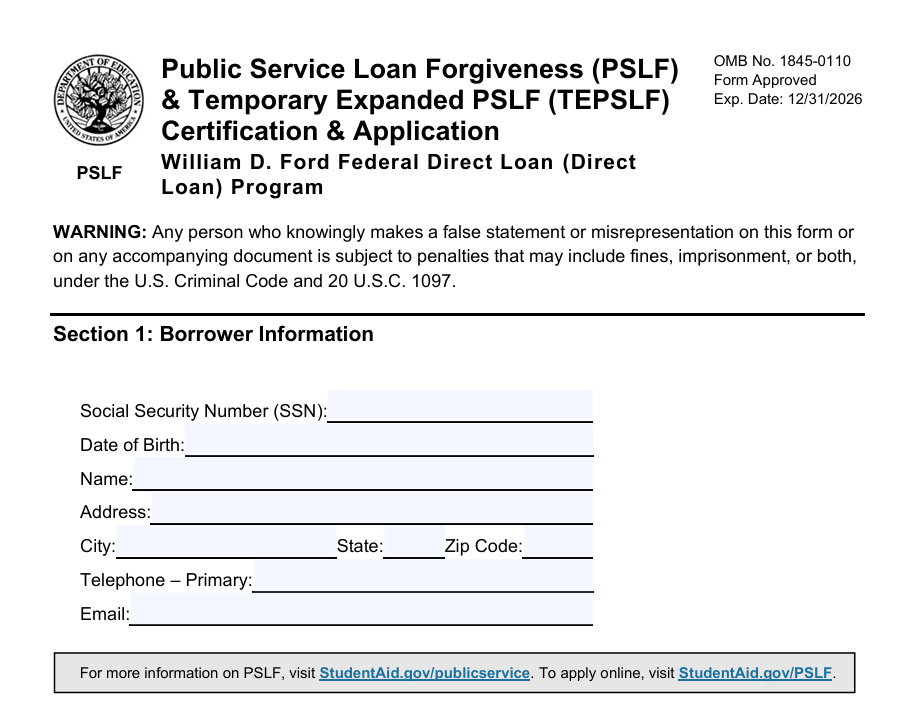
After downloading and printing the PSLF Employment Certification Form, fill in your personal information. This includes your name, address, Social Security number, etc.
Step 2: Sign the terms and conditions
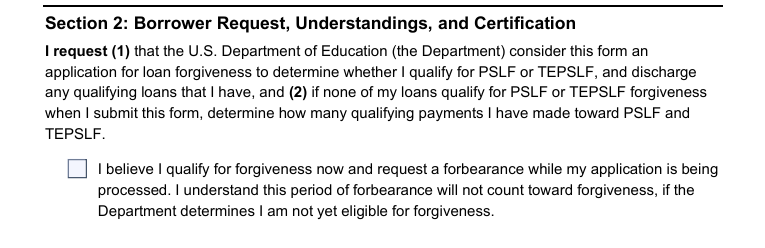
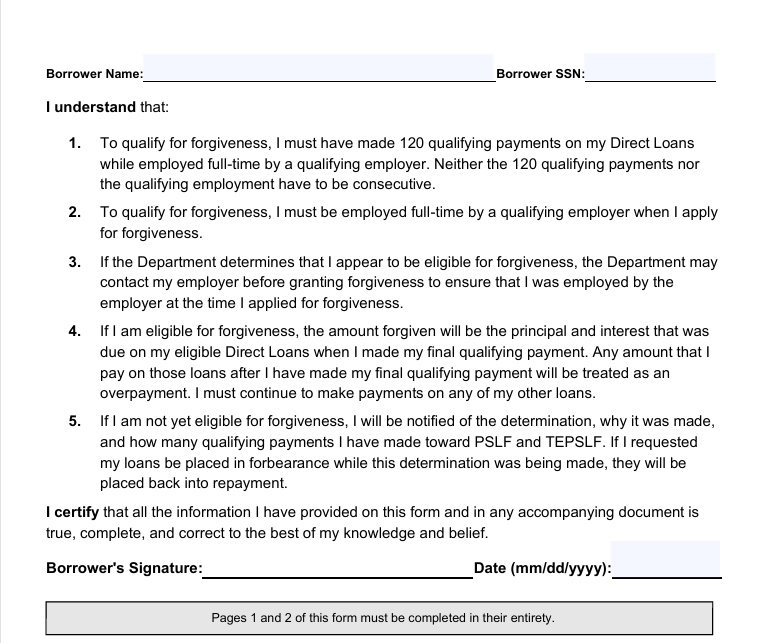
The second part of the form is the fine print. You’ll authorize that you understand how the program works, the eligibility requirements and how to qualify. Note that you must be on a qualifying repayment plan. Current income-driven repayment programs include Pay As You Earn (PAYE), Income-Contingent Repayment (ICR) and Income-Based Repayment (IBR).
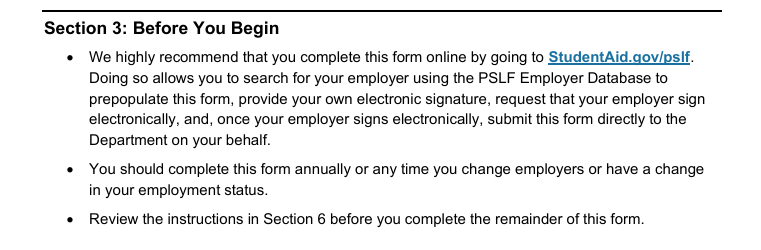
Section 3 includes tips and information to help you correctly submit your form.
Step 3: Give the form to your employer to fill out Sections 4 and 5A
Section 4 of the PSLF Employment Certification Form should be filled out by you or your qualifying employer. Since your employer will have all the necessary information and will need to certify the form, you can also have them fill out this section.
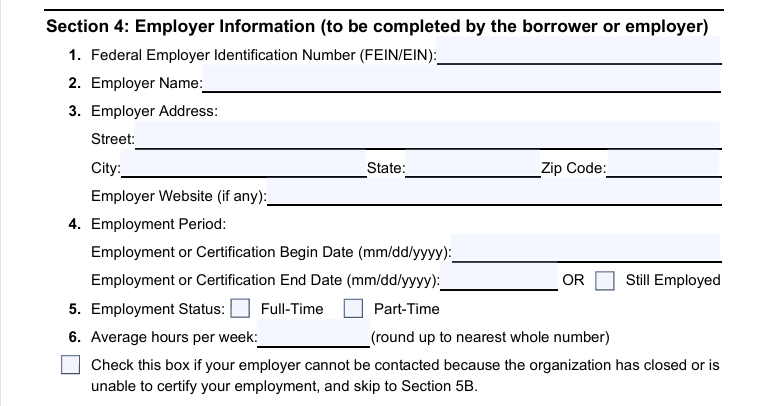
This section includes basic information about your employer, start and end date, employment status and hours worked. Your work must be considered full-time — not part-time — for your monthly payments to count toward PSLF and get your remaining balance forgiven.
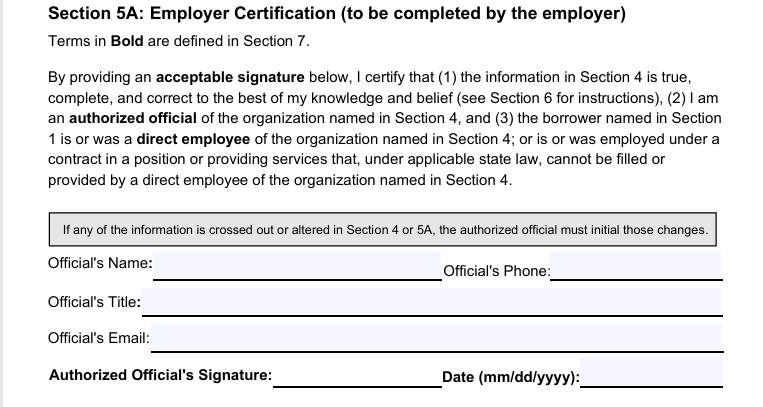
Once Section 4 is complete, an authorized official from your organization will need to fill out and sign Section 5A.
Step 4: Send in the completed form
Additional sections are provided to help explain how to correctly complete your PSLF Employment Certification Form, including information for alternative documentation.
Once you’ve completed the PSLF Employment Certification Form, you’ll need to send it directly to the U.S. Department of Education. You can do this by mail, fax or through the StudentAid.gov website:
Mail:
U.S. Department of Education
P.O. Box 300010
Greenville, TX 75403
Fax:
540-212-2415
Online:
You can upload the form by logging into StudentAid.gov and visiting “My Activity”.
After certifying the first time, you should complete this form once a year and each time you change jobs.
Related: How to Get an Electronic Signature for Public Service Loan Forgiveness
Why recertification is important
Certifying your employment the first time is important because you can make sure your employment qualifies. Note that if the Department of Education fails to get back to you about your certification status, you can ask for a manual recount of your payments.
But recertifying each year is important, too, for several reasons. First, it can help you track your student loan repayment, so you know you’re on your way to making 120 payments. On top of that, if you change jobs, you can ensure that your new employment still qualifies for the Public Service Loan Forgiveness Program, so there are no surprises.
If you don’t recertify, there are no hard consequences — but you’ll have to submit the PSLF Employment Certification Form for the previous 10 years of work. Might as well stay on top of it as you go through the process.
Mistakes to avoid with the PSLF Employment Certification Form
There’s been press about borrowers not receiving student loan forgiveness through PSLF, but some of that is user error. To ward off any issues, here are some common mistakes to avoid:
- Not filling out the form completely. Any blank space should be filled in.
- Forgetting to sign and date the form.
- Not turning in the form every year of employment.
- Not recertifying when changing jobs.
- Not having an official from your employer fill the form out.
- Not following up with your employer about filling out their part.
- Not submitting the form to the right place.
- Not keeping copies for your own records.
Opting for student loan forgiveness under PSLF can be great for the right borrower. You can get your loans wiped away after 10 years and won’t have to pay taxes on the amount forgiven — but you must stick to the process to have this happen.
If you avoid these common mistakes, you can stay on track with your student loan forgiveness under PSLF. Submitting your form each year can make the process easier and prevent issues down the line.

Not sure what to do with your student loans?
Take our 11-question quiz to get a personalized recommendation for 2026 on whether you should pursue PSLF, IDR, or refinancing (including the one lender we think could give you the best rate).
Comments are closed.